Agent configuration · Live quotas · Tool telemetry
harnez manage agent harnesses from one config.yaml.
Configure Claude Code, Antigravity, Codex and Prime Agent declaratively. Idempotent configuration, hook interception, live quota and hardware monitoring, and SQLite tool telemetry keep agent workflows observable.
AI coding agent setups drift across machines and providers. Tool permissions wipe on updates, prompt conventions diverge across repositories, multi-agent skills need disparate target directories, and unexpected rate limits or silent tool failures stall workflows without telemetry.
Declarative Source of Truth & Native Hooks
A single declarative config.yaml idempotently manages global configs, local project scaffolding, and cross-agent skills. Two-stage PreToolUse hooks rewrite commands to proxy stdio unbuffered and capture execution metrics directly into a local SQLite database.
Deterministic, Observable Engineering
Zero drift across all agent harnesses, one-command project onboarding via harnez init, live cross-provider quota tracking with rate-limit protection, and quantitative tool call reliability metrics via harnez stats.
Unified Token, Quota & Hardware Dashboard
Unified Token, Quota & Hardware Dashboard
harnez usage --watch
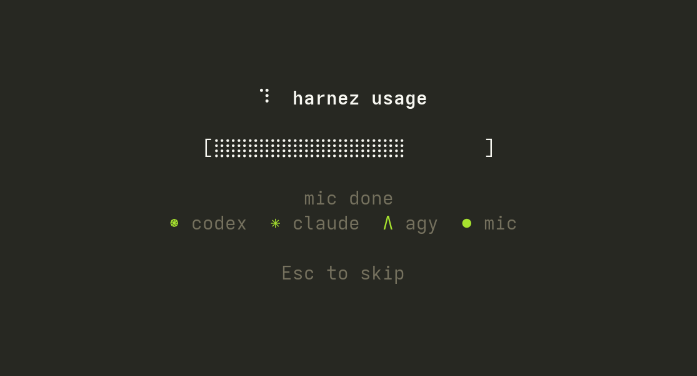
Provider and microphone readiness at startup.
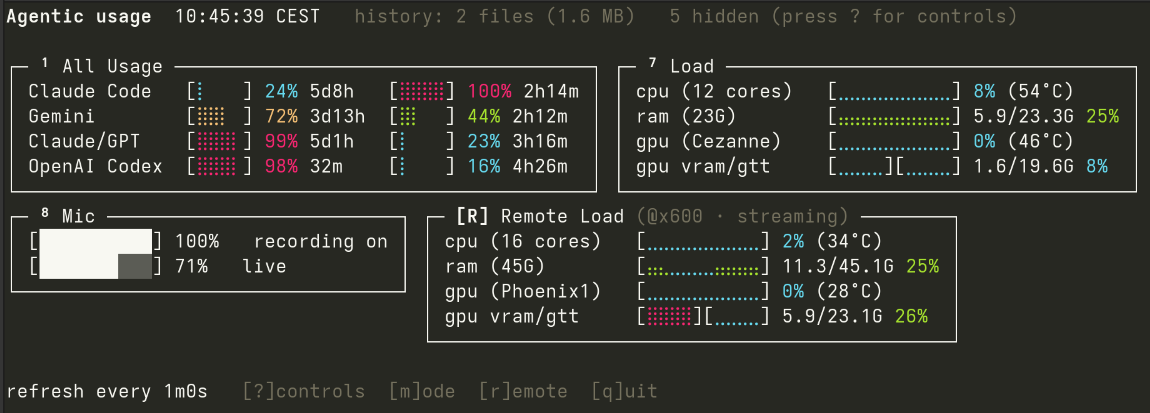
harnez usage (aliases: quota, tokens) unifies live rate-limit quota windows, token velocity sparklines, host hardware load, remote SSH nodes, and microphone speech meters into one interactive btop-style dashboard.
Instant Splash Status: Red/green brand glyphs (● codex, ✱ claude, Λ agy, ● mic) provide sub-second verification of provider connectivity and recording state on startup.
Multi-Provider Quotas
Live 5-hour and weekly rate limits for Claude Code, Gemini/Antigravity, and OpenAI Codex with reset countdowns and shared file-locked disk caching.
Hardware & Remote Streaming
Local CPU, RAM, and GPU/VRAM telemetry (AMD Cezanne/Phoenix, NVIDIA) alongside remote node metrics streamed over SSH (--host @x600).
Live Speech & Mic Ballistics
PipeWire (pw-record), ALSA (arecord), and PulseAudio live input capture with logarithmic dBFS scaling and equalizer-style visual decay.
# live btop-style dashboard with tokens/min sparkline and hardware load
$ harnez usage --watch          # -w

# compact one-shot summary for status bars and quick CLI glances
$ harnez usage --summary        # -s

# stream live telemetry from a remote compute node over SSH
$ harnez usage --watch --host user@x600

# inspect JSON output for custom statuslines or automation
$ harnez usage --json
Tool Telemetry & Analytical Reporting
Tool Telemetry & Analytical Reporting
The figures below are a historical sample from the original page, including a September 2026 heartbeat. They are not live counters.
Tracked tool calls
5,800+ captured non-blocking
Distillation byte savings
54.3%
Average tool score
4.82 / 5
Claude harness failure rate
3.9%
harnez stats queries the local SQLite telemetry database populated by harnez exec and harnez rate. It breaks down call frequency, quality scores, failure rates, and distillation byte savings across tools, agents, and repositories.
Tool / Dimension
Sample Calls
Avg Score (1–5)
Failure Rate
Operational Role
Bash (via harnez exec)
5,594
4.82
4.1%
Proxied shell execution with automatic exit scoring
High-reliability read-only and code-writing operations
heartbeat (rate --ok)
37
n/a
0.0%
Lean liveness assertions (issue 179)
Agent: Claude Code
5,337
4.85
3.9%
Primary agent session attribution via session ID
Agent: OpenAI Codex
553
4.42
9.4%
Codex exec interception & telemetry tracking
Agent: Antigravity (AGY)
21
5.00
0.0%
Native hooks.json PreToolUse interception
# render the full analytical report with tool, agent, and project breakdowns
$ harnez stats

# filter report to the current session (resolved from environment)
$ harnez stats --auto

# inspect feedback token overhead and distillation ratios
$ harnez stats --overhead --project harnez

distillation byte savings: 54.33% (27,957 -> 12,769 bytes)
heartbeat (harnez rate --ok): 37 recorded, last at 2026-09-07T07:19:55Z
feedback overhead: 28.1 avg bytes/call, ~943 one-time instruction tokens
Two-Stage Hook Interception
PreToolUse hooks rewrite commands into harnez exec -- <cmd>. The hook process exits immediately; the wrapper proxies unbuffered stdio, captures timing and exit codes, and writes SQLite telemetry in a bounded goroutine without blocking the agent.
Noise Distillation Engine
harnez distill automatically strips passing test noise, repetitive logs, and ANSI escape codes before output enters the agent's context window, saving over 50% in context tokens and bandwidth.
Native Multi-Agent Hooks & Shims
Includes dedicated adapters: quiet guarded bash PATH shim for Google Antigravity, Claude Code settings.json hooks, and Codex shell wrappers.
Core Engine Features
Core Engine Features
Multi-Agent Harness
Centralizes skills, permissions, and conventions across Claude Code (~/.claude), Google Antigravity (~/.gemini), Codex (~/.codex), and Prime Agent (~/.prime).
Non-Destructive Key Merging
Permissions, effort levels, and hooks in settings.json are merged cleanly. User themes, authentication tokens, and manual overrides remain completely intact.
Equalizer-style smooth decay and speech-activated dynamic refresh rates via PipeWire (pw-record), ALSA, and PulseAudio with logarithmic dBFS scaling.
Repository Discovery & Issues
harnez find and harnez issues offer fast fuzzy search, next-ticket reservation, and automatic README index synchronization.
Copyable Language & Practice Docs
Bundles battle-tested conventions for Go, Bash, Make, Rust, Zig, C++, GTK4, Markdown, Canary-first probes, Spec architectures, and Agentic Loops.
Concise Mode Switching
harnez mode adjusts prompt terseness levels dynamically and syncs AGENTS.local.md overlays across active workspace repos.
One-Command Project Scaffolding
harnez init provisions AGENTS.md, symlinks CLAUDE.md, installs requested language docs, and reconciles Makefile targets.
Release & Forge Automation
harnez release coordinates semantic version bumps, builds, minisign signatures, and Codeberg release forge uploads.
Commands Reference
Commands Reference
Self-contained, fast Go binary with no external dependencies required for daily workflows.
Command
Key flags
What it does
apply
-c-t-d--force-docs
Sync global Claude, Gemini, Codex, and Prime Agent rules, prompts, skills, and docs idempotently
usage
-w-s--host--mic--json--offline
Live dashboard & sparkline monitor for token quotas, CPU/RAM/GPU load, and mic speech ballistics
stats
--auto--overhead--project--tool--json
Analytical report over tool call frequency, average quality score, failure rate, and byte savings
exec
--tool--expect-failure--distill
Proxy stdio unbuffered, execute commands, and record non-blocking telemetry rows to SQLite
distill
--hook
Strip low-signal test suite noise, ANSI escapes, and redundant output to conserve context tokens
init
-c-d--docs-m-y--update
Set up a project directory: AGENTS.md, doc copies, git mode, and Makefile targets
diff
-c-t-e
Preview pending changes without writing (-e, --exit-code returns 1 on drift)
find
-dissuesdocs--json
Fuzzy search across tickets, documentation entities, and compute next issue numbers
issues
newstartclose-d
Change ticket status, resync issues/README.md, and commit in one atomic step
mode
conciseverbosenormal
Switch concise mode terseness level and update AGENTS.local.md overlays
rate
1-5--ok--note
Record tool quality feedback score or a lean heartbeat into telemetry SQLite database
release
patchminormajor
Run version bump, test suite, binary build, minisign signing, and forge release publication
revert --managed
-c-t--managed
Remove managed keys from settings.json and strip managed Markdown blocks
status
-c-t
Print configuration summary and verify applied file integrity on disk
Architecture
How it works
1. Two-Stage Hook Interception
PreToolUse lifecycle hooks rewrite tool invocations (such as Bash or run_command) into harnez exec wrappers. The hook returns instantaneously, letting harnez exec supervise execution, proxy unbuffered stdio, and write telemetry asynchronously to SQLite.
2. Key Merge, Not Replace
harnez only mutates keys it explicitly manages (effortLevel, permissions, hooks, env, spinnerVerbs). User preferences, dark themes, and auth tokens in settings.json and hooks.json are strictly preserved.
3. Managed Markdown Boundaries
Content in AGENTS.md and CLAUDE.md is bounded by HTML comments (<!-- harnez:begin ... -->). Custom rules, project architectures, and unmanaged sections outside those comments are never overwritten.
4. Shared Caching & Lock Coordination
Live quota queries and hardware metrics are cached on disk with file locks (~/.claude/harnez-quota-cache.json). Multiple running terminals and agent subprocesses share cached readings without hitting upstream API rate limits.
Recent milestones include repeat-safe agent deletion and missing-session recovery (issue 688), spec-driven usage view modes (678), role inference and fuzzy session resume (686, 692, 695), and an Antigravity tool rejection hook (694). The agent harness story connects these changes to the repository’s recorded workflow.